
What Probate Court Handles in Baraga County
Probate court exists to sort out what happens to a person's property, debts, and personal welfare when they can no longer manage those things themselves, or after they have died. In Baraga County, the probate court handles the estate of someone who has died, whether or not they left a will, along with the trusts tied to that estate. It also takes on cases that have nothing to do with death at all. Guardianship cases, where the court appoints someone to make decisions for a child or an incapacitated adult, and conservatorship cases, where the court appoints someone to manage another person's money and property, both run through the same probate office. Mental health matters, including involuntary treatment proceedings, are heard here too.
Baraga County Probate Court sits inside the same courthouse cluster used by the county's district and circuit courts, at 16 N. Third Street in L'Anse. Judge Hon. Timothy S. Brennan presides over probate matters, working alongside a staff dedicated to estates, guardianships, and juvenile-related probate work.
The Baraga County Probate Court
Baraga's probate office is staffed for the specific kind of casework it handles, not run as a side desk of another court. Probate Registrar Madeline Barnett manages the estate and guardianship side of the docket, while Juvenile Registrar Tessa Gilbertson and Juvenile Case Worker Dawn Howe handle matters that touch minors, such as juvenile guardianship filings that stay in probate rather than moving to circuit court. Reaching the right person by extension saves a caller from being transferred multiple times, since estate questions and juvenile-related probate questions go to different staff members inside the same office.
Baraga County Probate Court
16 N. Third Street
L'Anse, MI 49946 (ext. 7)
Probate Registrar Madeline Barnett: ext. 206
Juvenile Registrar Tessa Gilbertson: ext. 207
Juvenile Case Worker Dawn Howe: 906-524-9216
Fax: 906-524-2052
Calling ahead with the correct extension for either registrar cuts down on hold time, since estate filings and juvenile probate matters route to separate staff inside the same L'Anse office.
Baraga County Probate Terms Defined
Probate filings use a specific vocabulary that can be confusing to someone searching for a record for the first time. A handful of terms show up again and again across estate, guardianship, and conservatorship cases, and knowing them in advance makes it much easier to read a docket entry or a court form correctly. The definitions below cover the terms most likely to appear in a Baraga County probate case, from the person who wrote a will to the person a court appoints to manage someone else's affairs.
- Testator
- A person who made a valid will before dying.
- Executor
- The person named in a will to carry out its instructions and manage the estate through probate.
- Intestate
- Describes someone who died without a valid will, meaning state law decides how their property is divided.
- Guardianship
- A court arrangement that gives one person legal authority to make personal and medical decisions for a minor or an incapacitated adult.
- Conservatorship
- A court arrangement that gives one person legal authority to manage the money and property of someone who cannot manage it themselves.
- Trust
- A legal arrangement where property is held and managed by one party for the benefit of another, often used alongside or instead of a will.
Where Baraga Probate Matters Are Filed
Probate cases are not filed wherever it is convenient. Michigan's venue rules point each type of case toward a specific place based on where the person involved lives, is located, or owns property, and Baraga County follows those same rules. A deceased person's estate, for example, belongs in the probate court where they lived, unless they were not a Michigan resident, in which case the case goes to the county where they left property. Wills and trusts follow that same pattern. Guardianship and conservatorship cases usually follow the person who needs protection rather than a piece of property, while mental health cases go where the person is found if their residence cannot be pinned down. Getting the venue right the first time avoids a case being filed in the wrong county and having to start over.
| Matter | Where It Is Filed |
|---|---|
| Deceased estates | County where the deceased resided, or where they left property if not a Michigan resident |
| Wills and trusts | County where the deceased resided, or where the property is located for a nonresident |
| Mental health matters | County where the person resides, or where they are found if residence cannot be determined |
| Guardianship | County where the person resides, is present when the case begins, or is admitted to an institution by court order |
| Conservatorship | County where the person resides, or where their property is located if they are a nonresident |
Note: Some juvenile guardianship and conservatorship matters are heard in the family division of circuit court instead of probate, so venue can shift for younger cases.
How to Search Baraga County Probate Records
Probate cases that have been entered into Michigan's statewide system can be searched through MiCOURT Case Search, the same public portal used for district, circuit, and other trial court records across the state. The portal's case-type filters include a dedicated probate category, and the underlying MiCOURT case-search system can expand a case to show its petitions, listed participants, assigned judge, and next scheduled hearing where that information has been published. Not every probate record is online, though. Older filings, sealed matters, and records tied to sensitive proceedings such as guardianship of a minor or a mental health case may only be available by visiting the Baraga County Probate Court in person or requesting a copy directly from the office.
The Michigan State Court Administrative Office publishes the statewide probate court forms used to open an estate, request guardianship, or file a conservatorship petition in Baraga County.
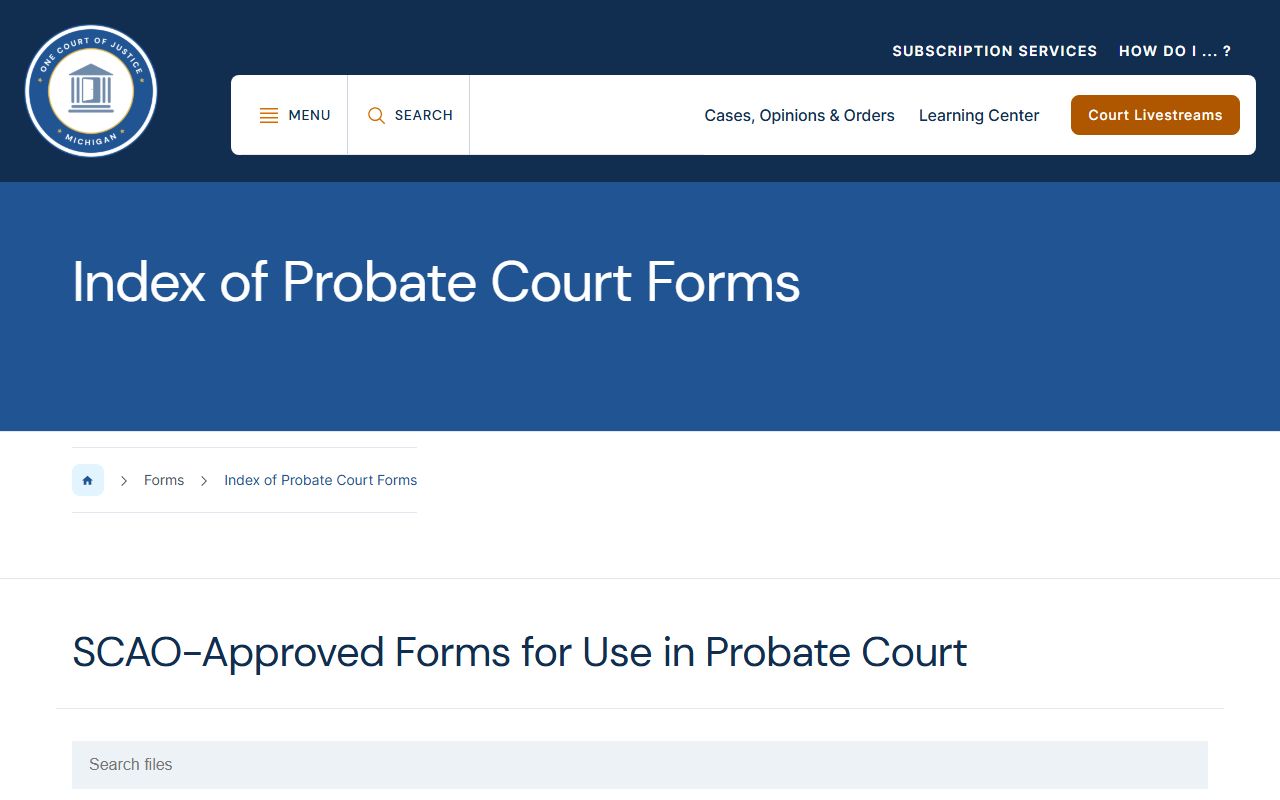
Those standardized SCAO forms are accepted by every Michigan probate court, including Baraga's, and using the current version helps avoid a rejected filing.
- Start with MiCOURT Case Search and filter results to the probate case-type category to narrow results to estate, guardianship, conservatorship, or mental health filings.
- Search by the participant's last name or by case number if it is already known. Name searches match results that begin with the letters entered.
- Review the case summary for the judge, filing date, and next hearing where MiCOURT has published that data.
- Contact the Baraga County Probate Court directly, or visit the office at 16 N. Third Street in L'Anse, for records that are not available online.
What Baraga County Probate Records Show
A published probate case in MiCOURT generally shows the basic shape of the matter rather than every document filed in it. Expect to see the case number, the case type category of probate, the participants connected to the filing, and the judge assigned to hear it. When a hearing is scheduled, the next hearing date is often part of the same record. What is missing from the online summary, in many cases, is the underlying paperwork itself, things like the actual petition, an inventory of estate property, or an accounting filed by an executor or conservator. Those documents typically have to be requested from the probate office directly.
Because probate cases often unfold over months or years, checking a case more than once is normal. A guardianship or conservatorship can stay open for years while the court periodically reviews it, so the record a searcher sees today may look different a year later.
Redaction and Restricted Probate Filings
Michigan court rules shape what a member of the public can actually see in a probate file. MCR 1.109 defines court records broadly, covering pleadings, orders, and judgments, but it also protects certain personal identifiers, including a person's date of birth, Social Security number, driver's license number, and financial account numbers, which generally must be redacted from public copies. MCR 8.119 is the companion rule that governs public access itself. It treats most case records as open unless a specific statute or court rule makes them nonpublic, which means the default in Baraga County, as everywhere in Michigan, leans toward access rather than secrecy. Probate cases test that balance more than most, since they frequently involve minors, elderly or disabled adults, and mental health information.
A juvenile guardianship or conservatorship case in Baraga County can sometimes be heard by the family division of circuit court rather than probate, depending on how the matter arises, so a search that comes up empty in probate may need a second look at circuit court.
Getting Copies and Help From Probate
There is no single online button that answers every Baraga County probate question, so it helps to know the full set of channels before starting a search. Michigan's official quick-reference guide for trial courts confirms that probate, covering estates, wills, mental health, guardianship, and conservatorship, is one of the matter categories tracked at the county level, and Baraga's own probate office backs that up with a staffed phone line rather than an automated system. A caller who is not sure where a file stands is better off starting with a person than guessing from an online summary.
- Online: MiCOURT Case Search for probate cases the court has published.
- In person: the Baraga County Probate Court office at 16 N. Third Street in L'Anse.
- Phone: Probate Registrar Madeline Barnett at ext. 206, or Juvenile Registrar Tessa Gilbertson at ext. 207 for juvenile-related probate matters.
- By request: a direct copy request to the probate office, or a formal request through the county's Clerk of Court FOIA process if the record is not released informally.
Marriage ceremonies in Baraga County can be performed by a probate judge as well as by district and municipal judges under Michigan court rules, though marriage licenses themselves are issued separately by the county clerk, covered on the marriage and divorce records page.