
Active Warrants in Baraga County
A judge or magistrate issues warrants tied to Baraga County cases. Most start small. A district-level warrant usually begins with a complaint or a missed court date, handled through the Baraga County District Court. A felony matter can carry warrant activity into the Baraga County Circuit Court once the case is bound over. Michigan Court Rule 1.109 treats both arrest warrants and bench warrants as court records. That same rule covers pleadings, orders, and judgments filed with the court.
No official Baraga County page publishes a live warrant list. That is worth remembering. The Baraga County sheriff page does not host a searchable warrant database. Neither does the district court page, and neither does the circuit court page. The gap does not mean a Baraga County warrant does not exist. It means the record sits with whichever office holds the underlying case, not in a single county search box.
How to Check a Baraga Warrant
Baraga County does not run its own online warrant search. Checking on a warrant here means working through a short chain of offices, in order. Each stop can confirm or rule out part of the picture. Skipping straight to an outside name-search website rarely gives a reliable answer.
- Search the MiCOURT Case Search for an open Baraga County case tied to the name in question.
- Call or visit the Baraga County District Court for status on misdemeanor complaints and early felony matters.
- Contact the Baraga County Circuit Court for felony warrants tied to a case after bindover.
- Call the Baraga County Sheriff's Office for custody status and warrant-service questions.
- File a FOIA request with the county for warrant-related records that are not visible online.
- Run a name through ICHAT only for a general criminal-history background, not as a warrant check.
Baraga County Sheriff's Office for Warrants
The Baraga County Sheriff's Office is the county's enforcement and custody contact for warrant matters. It stays open every hour of the year. Sheriff Joe Brogan and Undersheriff David Miller lead the office. Its duties include patrol on county roads, execution of court orders and civil process, court security, and operation of the county jail. None of those duties include publishing a warrant list. Still, the office is the right call once a warrant leads to an arrest or a custody question.
The sheriff page also keeps an approved bail-bondsman list. A firearms-disposition inventory sits there too. Both matter once a warrant turns into a bond or property question.
Baraga County Sheriff's Office
940 US Highway 41
L'Anse, MI 49946
906-524-6100 ext. 695
Fax 906-524-5577. Open 24 hours a day, 7 days a week.
Arrest Warrants and Bench Warrants
Baraga County warrant records generally fall into a couple of categories. Both types are court-issued. The triggering event differs for each one, though, and that difference decides which office is most likely to have current status.
- Arrest warrant - issued when a judge or magistrate finds probable cause on a new complaint, typically starting at district court.
- Bench warrant - issued when someone misses a scheduled court date or violates a condition in an existing case.
- Felony warrant after bindover - once a district case is bound over, further warrant activity connects to circuit court records instead.
Note: bench warrants often stay tied to the local court docket that produced them rather than appearing on any separate county-wide list.
District and Circuit Court Warrant Routing
Which Baraga County court holds the warrant record depends on where the case sits in the system. Michigan routes misdemeanors, and the early stages of a felony, through district court. That includes arraignment and the preliminary examination. Once a felony case is bound over, circuit court takes on the file. Any warrant tied to a failure to appear, or a probation violation, typically follows the case there.
Bond and initial warrant questions at the district level often go through the magistrate's office. The clerk's office handles docket status and warrant paperwork instead. Baraga County District Court lists Magistrate Nicole Frisk and Clerk Kaytlinn Ellis among its staff. A courthouse fax line is also available for written follow-up requests.
A Baraga County criminal matter generally moves from District Court to Circuit Court after bindover, and on to the Michigan Court of Appeals. A warrant tied to that case can follow the same path.
What a Baraga County Warrant Record Shows
Baraga County does not publish a sample warrant record online. There is no live example to walk through. Michigan Court Rule 1.109 describes the kind of information in the court-record universe once a document, such as a warrant, is filed. That framework lines up with the fields a clerk or the sheriff would reference when confirming a warrant by phone or in person.
| Field | What It Shows |
|---|---|
| Issuing Court | Whether the warrant traces to Baraga County District Court or Baraga County Circuit Court. |
| Case Number | The docket number tied to the underlying complaint or case file. |
| Defendant Name | The person named in the warrant, as filed with the court. |
| Warrant Type | Whether the record is an arrest warrant or a bench warrant. |
| Underlying Charge | The offense or violation connected to the warrant. |
| Date Issued | The date the judge or magistrate signed the warrant. |
| Bond or Bail | Any bond amount set for the matter, when the court has set one. |
ICHAT and Warrant Checks in Baraga County
The Internet Criminal History Access Tool, known as ICHAT, is the Michigan State Police's public name-based criminal-history search. It is not a warrant tool. ICHAT reports felonies and serious misdemeanors punishable by more than 93 days, from all 83 counties. Those records come from the department's Criminal Justice Information Center. ICHAT covers conviction history, not warrant status. It is often the first stop for a general background check on a Baraga County name, even though it cannot answer the warrant question.
The Michigan State Police explain the scope and limits of the ICHAT criminal-history tool on the department's own service page.
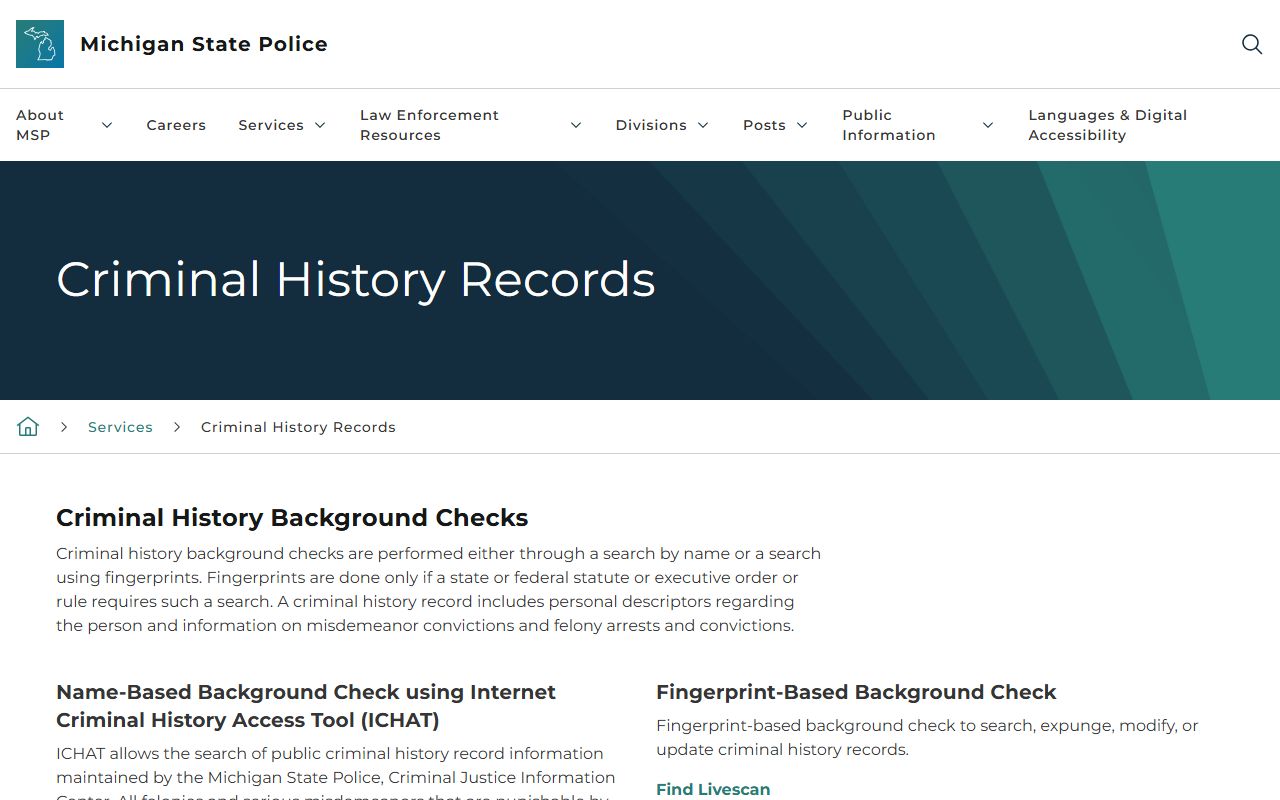
That page is worth reading in full before anyone relies on a clean ICHAT result to rule out a Baraga County warrant.
Important: ICHAT does not provide warrant information or suppressed records, so a clear ICHAT report never confirms that no Baraga County warrant exists.
What to Do About an Outstanding Warrant
Confirming a Baraga County warrant is only the first step. The court that issued it is the office that can resolve it, not the sheriff and not a background-check website. District court handles the matter when the warrant is tied to a misdemeanor or an early felony stage. Circuit court takes over once a felony case has been bound over.
The Baraga County Sheriff's Office carries out warrants once a court issues them. An outstanding warrant can lead to an arrest at any contact with law enforcement, even a routine traffic stop. Waiting rarely helps. Resolving the warrant directly with the issuing court is the surest way to get a bond set, a hearing scheduled, or the warrant recalled.
Anyone booked into the county jail on a Baraga County warrant appears through the sheriff's custody process, not a warrant list. That custody status is covered separately on the Baraga County inmate records page. The charge tied to the warrant is tracked through the channel described on the Baraga County court charge records page.
Warning: Do not ignore a Baraga County warrant. Contact the issuing court, or a lawyer, before deciding how and when to appear.
FOIA Requests for Baraga County Warrants
Sometimes a Baraga County warrant-related record is not visible through the court or the sheriff. A written Freedom of Information Act request is the formal fallback then. Baraga County's FOIA summary of procedures says requests must be in writing. They can be submitted in person, by mail, by fax, or by email. No specific form is required, though the county keeps a FOIA request form on its documents page.
Baraga County FOIA Coordinator Wendy J. Goodreau processes warrant-related requests out of the clerk's office. A written response is due within five business days. A ten-business-day extension is possible for larger requests. If the estimated cost runs above fifty dollars, the county can require a deposit before pulling records together.
Note: a Baraga County FOIA request covers records not otherwise public online, but it does not create a live warrant-status check the way a call to the issuing court can.
Restrictions on Baraga Warrant Records
Public access to Baraga County court records runs through Michigan Court Rule 8.119. That rule treats case records as inspectable unless a statute or court rule makes them nonpublic. Even so, real limits remain on what a warrant search can confirm. A case can exist in the system without every enforcement detail showing up in a public search. Some matters, including juvenile warrant cases, stay outside general public view.
A person can have an active Baraga County warrant that never shows up in ICHAT. A public court search may list the case without listing every enforcement action tied to the warrant.
Does a clean ICHAT report mean there is no Baraga County warrant? No. ICHAT is a criminal-history tool, and the Michigan State Police say plainly that it does not return warrant information or suppressed records. Confirming warrant status takes a direct check with the issuing court or the sheriff's office.